Can These Four Mega Projects Drive the Next Growth Cycle for Property in Noida?
Infrastructure has played a defining role in shaping Noida’s real estate market. As new expressways opened, metro lines expanded, and commercial hubs took shape, buyers and businesses shifted towards those locations, whether it was Noida Expressway, Greater Noida, or the Yamuna Expressway.
Another wave of large-scale projects is now putting the region back in the spotlight. The expansion of Namo Bharat, the proposed Namo Cities under NCR Plan 2041, fresh investment commitments announced during the UP Global Growth Dialogue 2026, and the proposed Ganga Expressway link, all point towards long-term regional growth.
For homebuyers, investors, and businesses, these projects raise an important question: Could they influence where the next growth corridors emerge? Understanding how these developments fit into Noida’s larger growth story can provide useful context when evaluating flats for sale, office spaces in Noida or the city’s long-term investment potential.
Quick Snapshot: Four Projects Shaping Noida’s Next Growth Phase
Before we discuss each of these new large-scale developments, let’s have a quick overview of the current status of the projects and the expected completion timeline.
| Project | Current Status | Expected Timeline |
| Namo Bharat Expansion | Secured Union Cabinet approval | Completion date and milestones are yet to be officially announced. |
| Namo Cities | Proposed plan awaiting approval | The cities are mentioned under the NCR Plan 2041. The timeline hasn’t been announced. |
| ₹29,000 Crore New Investments | Investment commitments announced in UP Global Growth Dialogue 2026 | To be executed in phases over the coming years, subject to project approvals. |
| Yamuna-Ganga Link Expressway | Approved. Land acquisition and planning underway | Expected to be completed by 2029 (subject to construction progress). |
How Could the ₹19,390 Crore Namo Bharat Expansion Improve Property in Noida?
This newly proposed expansion project is expected to improve connectivity between Gurugram, Faridabad, Noida, and Greater Noida, making travel across these major NCR cities faster and more convenient. While the project is primarily aimed at improving regional mobility, it could also influence how people choose where to live.
When travelling becomes easier, homebuyers often start looking at areas beyond those closest to their workplaces. Locations that offer larger homes, better amenities, or more competitive prices become practical options as long as daily travel remains convenient.
Improved connectivity can benefit in different ways:
- Working professionals may find it easier to live in Noida or Greater Noida while commuting to business hubs across the NCR.
- Families could have more flexibility to choose neighbourhoods with good schools, hospitals, parks, and other everyday conveniences without sacrificing accessibility.
- Rental demand may also improve as tenants generally prefer locations with easy access to multiple employment centres.
Some residential corridors are better positioned to benefit from this improved connectivity. Established residential corridors like Noida Expressway , Greater Noida and Sector 150 already attract buyers because of their competitive property prices, planned communities, growing social infrastructure and strong regional connectivity. Meanwhile, the Yamuna Expressway region also gains indirectly as improved access complements ongoing developments and industrial projects.
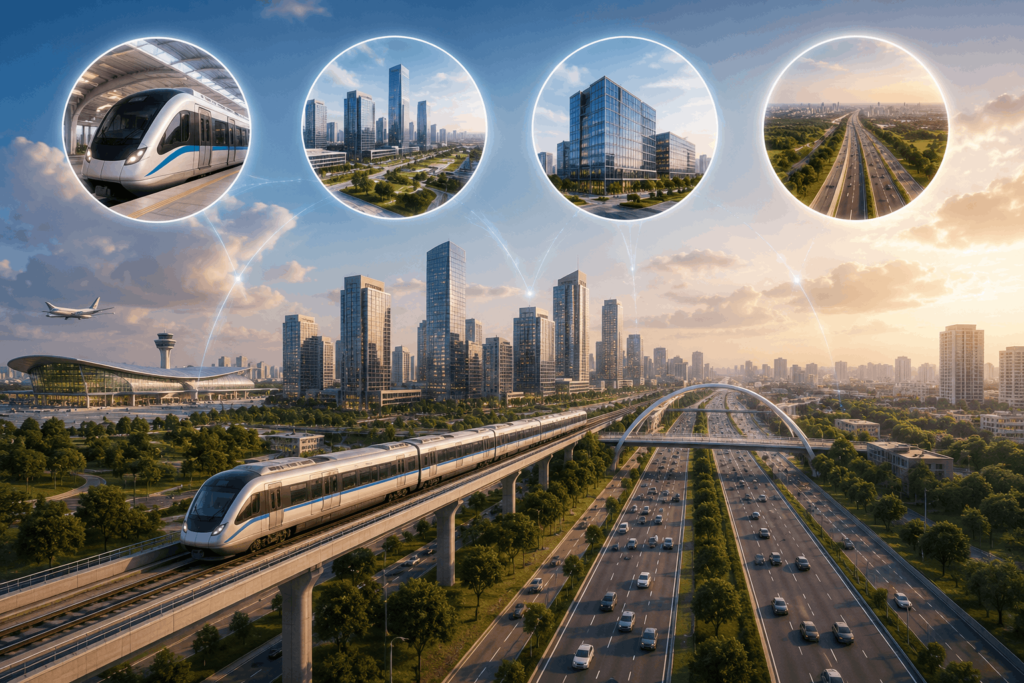
What Could the Proposed Namo Cities Mean for the Future of Property in Noida?
The proposed Namo cities are a part of the bigger NCR Plan 2041, which aims to spread growth more evenly across the National Capital Region instead of concentrating it around Delhi. The plan includes four new urban centres, one each in Delhi, Haryana, Rajasthan, and Uttar Pradesh.
The key highlight of the plan is the Transit-Oriented Development (TOD) programme that focuses on building homes, offices, schools, hospitals, retail spaces, and transport systems around the high-capacity Namo Bharat stations. Instead of piecemeal expansion, these cities will be structured as integrated urban centres.
Such development will make it easier for people to live closer to their workplace and access everyday services without travelling long distances. Businesses also benefit from better transport systems as they improve accessibility for employees, customers, and suppliers. As more companies move in, new jobs are created, and that naturally brings demand for housing, whether people buy or rent it.
Noida already has much of the infrastructure that supports this type of growth. Its road network, metro connectivity, residential sectors, commercial districts, and expressway are already in place. As new urban centres come up across the NCR, Noida is likely to remain closely connected to them for broader regional growth.
Can ₹29,000 Crore in New Investments Strengthen Demand for Property in Noida?
At the UP Global Growth Dialogue 2026, Uttar Pradesh attracted fresh investment commitments worth 29,000 crore. Several announced investment proposals are expected to benefit Noida and Lucknow, where developers have proposed projects ranging from Grade A office spaces and business parks to mixed-use developments.
The announcement also gives a glimpse into where the state wants to head next. Uttar Pradesh is actively pitching itself as a destination for Global Capability Centres (GCCs) and large corporate offices with a target of 500 GCCs and 40 million sq.ft. of Grade A office space by 2031. If these plans gather pace, Noida is likely to remain one of the key locations driving that growth.
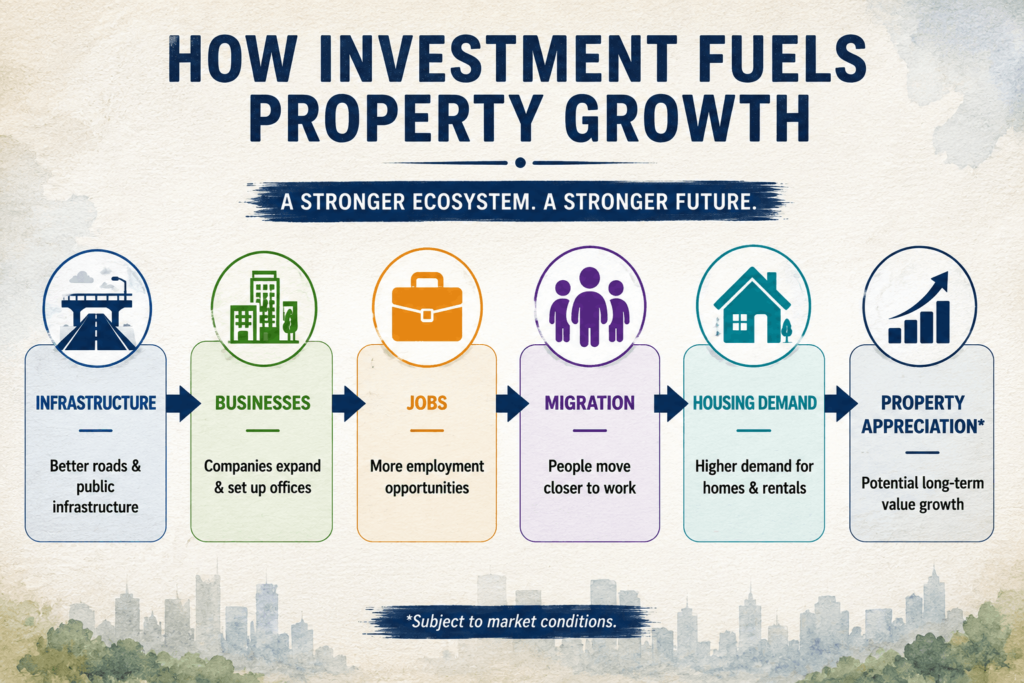
One thing worth noting is where these investments would be heading. Much of it is tied to office spaces in Noida and commercial projects. That’s significant because commercial investment usually has a ripple effect. As business districts grow, the surrounding areas often see higher demand for rental homes, apartments, retail outlets, cafes, schools, and other business services.
How Could Ganga Expressway Connectivity Expand Noida’s Growth Potential?
The proposed 74.3 km Greenfield Link Expressway may not be the biggest infrastructure project in Uttar Pradesh, but it could become one of the most important connectors. Estimated to cost around 4,000 crore, the road will link the Ganga Expressway with the Yamuna Expressway near Noida International Airport.
The project is being developed by UPEIDA and will pass through several villages across western Uttar Pradesh. It is designed to connect infrastructure that’s already taking shape.
- Noida International Airport becomes the centre of the network
- The Yamuna Expressway links the airport with Noida and Greater Noida
- The Ganga Expressway opens up access to cities across western, central, and eastern Uttar Pradesh
The new link road will be a connector, allowing it to function as one connected transport network instead of separate corridors. Districts such as Meerut, Hapur, Bulandshahr, Badaun, Shahjahanpur, Hardoi, Prayagraj, and other locations along the Ganga Expressway will get a more direct route to the Noida International Airport and the NCR. Shorter routes can benefit daily commuters, inter-city travellers, commercial vehicles, and freight operators alike.
Better road access means businesses in more parts of Uttar Pradesh can connect to it without taking long detours. For industries that rely on moving goods, whether it’s manufacturing, warehousing, logistics, e-commerce or exports, that kind of connectivity matters.
For the property market, the bigger takeaway is the way these projects are beginning to work together. Instead of looking at the airport, the expressways, or industrial corridors as separate developments, they’re gradually becoming parts of one larger network that strengthen several residential corridors and drive prices for sale in Noida.
Conclusion
These developmental projects create opportunities for businesses and jobs, and sustained economic activity will impact the property prices in Noida. The encouraging part is that the recent announcements aren’t limited to transport projects. They are also backed by commercial investments and long-term urban planning.
Better regional rail, planned urban centres, commercial investments, and Noida International Airport, and expressway connectivity are all being developed as a part of the larger ecosystem. If these plans move forward as intended, they could make Noida more than just an extension of Delhi. They could strengthen its role as a business, residential, and employment hub.